

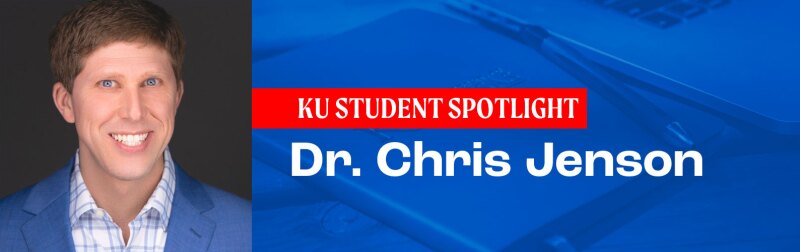
Dr. Chris Jenson’s professional path defies simple categorization. A former emergency health physician, who completed a fellowship with the Centers for Disease Control and Prevention, Jenson now works as a health consultant for school boards, state agencies, and districts across the country. His journey has taken him from high-stakes medical situations to high school classrooms and, most recently, to the University of Kansas online master’s in curriculum and instruction program.
“If you think of my career in three stages,” Jenson says, “Part one was clinical healthcare, part two was teaching in a high school, and part three merges the two together.”
Discovering a love of teaching
Jenson's career in medicine started as you would expect, “I was in healthcare, I was seeing patients. Totally clinical,” he recalls. But looking back, even his work as an emergency medicine doctor wasn’t just about diagnosing and treating patients. While working in hospitals, Jenson found unexpected joy in mentoring medical students and junior residents.
"Every time they would ask someone to work with med students or [for someone to] have residents [shadow] them. I was happy to do it."
That realization—coupled with a desire for more work-life balance—led him to consider education as a second career. He enrolled in the University of Kansas’s Graduate Licensure Program (GLP), which supports professionals transitioning from other fields into teaching. With his strong background in science, Jenson was able to jump into secondary science education after completing the program.
Teaching science as a launch pad for life skills
As a high school teacher, Jenson embraced his operational mindset and desire to help students prepare for real life. He viewed science not only as a subject, but also as a tool for teaching collaboration, organization, and resilience.
"Content mattered," he explains, "but I was more concerned about helping students develop life skills—how to problem-solve, how to work in teams, how to think critically."
Whether his students planned to go to college or directly into the workforce, Jenson saw his role as helping them extract meaning from their education and take ownership of their learning journey.
Bridging the gap between health and education
Over time, Jenson’s two worlds—health and education—began to overlap. While teaching in a large district, he recognized a growing demand for health expertise in schools and began advising on common challenges like how to fight opioid abuse, tamp down on vaping, or efficiently share nursing resources across rural districts.
"Schools were increasingly being asked to tackle complex health issues. Like: what do we do about youth mental health," he says. “A lot of educational leaders thought, if we’re going to be charged with doing something to help kids…let’s do something worthwhile instead of just checking a box.”
Not long after he started consulting, the COVID-19 pandemic happened and Jenson’s combined experience became even more valuable. “Having ten years of experience being in a classroom, I had a rough idea of what was possible in a school,” he explains, “I knew what was practical, what teachers and principals could handle, and so I tried to merge the science with the practicality of the job.”
By 2022 Jenson launched his own LLC and was consulting full-time helping schools to build operational health plans that were practical, data-driven, and tailored to each environment.
“Every school district's different,” Jenson says. “I mean, they could have the same problem, but if it's in two different locations, you might approach it very differently. It's kind of like medicine,” he reflects. “You could have 40 patients with chest pain and you can have 40 schools who are struggling with youth mental health—there'll be some overlap—but there'll be a lot of unique driving factors in each community that make it different.”
Going global with a master’s degree
When Jenson found a dream job—a health advisory position in New Zealand—that required a curriculum and instruction master’s degree, he knew where to turn.
"The first place I thought of was KU, simply because I’d had such a pleasant experience there the first time,” he says.
He found the program exciting, timely, and aligned with his goals. “I looked back at some of the curriculum I wrote after I took these courses, and I thought, ‘Oh, I can now see what was good about it, and what could have been way better,’” he says. “It's nice, because I had some real-life experience, and then I took the classes, and improved and now I see how I can take my work to the next level.”
The KU C&I curriculum helped him reflect on all the individual pieces of lesson design that shape educational experiences, from political influence and policy to governance and pedagogy. A course in linguistics drew his attention to the nuances of cultural sensitivity and communication—especially important as he prepares to move internationally.
Advice for traditional and nontraditional educators alike: choose KU
To anyone considering returning to school for a graduate degree, Jenson offers practical encouragement:
“There's never a perfect time to go back to school,” he reasons, “But, try to find some balance. You have to give yourself the grace of, ‘this is good enough.’ Some weeks, you can knock a project out of the park, because you have the time to do it, and really show your best abilities. Some weeks you’re under the thumb, but the professors get it.”
“The program was friendly, fair, well-designed, organized, and timely,” Jenson says, adding that even though his professional role differed from many of his peers who were working within typical classrooms, professors were always accommodating to his needs, ensuring that projects were applicable to his experience.
“[KU SOEHS faculty] are personable, helpful, direct, honest and empathetic,” he says. “They expect you to try, they expect you to work, it's the only way you're going to learn, but they're also human, and they are very understanding that you're immersed in life as you come back to school.”
Explore what’s possible with KU
Thanks to KU’s online master’s program, Chris Jenson has been able to advance his career, expand his impact, and bring evidence-based practices to the forefront of education policy and planning.
Jenson’s story reflects the kind of career transformation made possible through KU’s online education programs. Whether you're working in health, policy, nonprofits, education or other fields, a master's in curriculum and instruction* can help you expand your influence and open the door to new opportunities.
Ready to chart your own path? Schedule a call with an admissions outreach advisor to learn more about KU’s online master’s in education programs.
*This program is an online Master of Science in Education (M.S.E.) degree in curriculum and instruction. It does not lead to initial or advanced teaching licensure. Prior teaching experience is not required but is strongly recommended.