

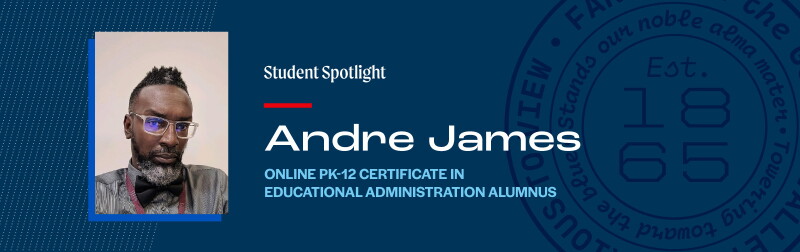
Andre James has been many things in his life: Army veteran, philosophy major, charter school teacher, math department chair, documentary subject, KU graduate, and now assistant principal. But ask him what he is at his core, and his answer is immediate.
"There's a difference between being an educator and a teacher," he said. "A teacher is a person that does the minimum. An educator is trying to build a whole person."
By that definition, James has been an educator since long before he ever set foot in a formal classroom. He spoke with the KU School of Education about the road that brought him here and where he plans to go next.
Growing Up in Charlotte
James grew up in Charlotte, North Carolina, raised largely by his grandmother in a household where no one had ever earned a bachelor's degree. His mother, fifteen when he was born, was among the first generation of students to attend desegregated schools in Charlotte—part of the generation shaped by the landmark Swann v. Charlotte-Mecklenburg Board of Education busing case. Education, in the James household, carried weight.
"She had these college handbooks where you have the different colleges, their description, how much it costs, tuition, what their majors are," he recalled. "And during the summer, as an 8- or 9-year-old, I'm looking through these schools and just dreaming. I want to go to Tennessee. I want to go to Maine. I've never been to none of these places. I ain't never been out of Charlotte."
He didn't know yet how he'd get there. Nobody in his household did. But the dream was real, and school was the thing that made it feel possible. "Just dreaming big," he said, "because school was something that allowed me to dream."
The practical answer came from his uncle, an ex-Marine who sat him down at the dinner table one evening with a clear-eyed assessment: "You talk about college a lot, but nobody in this household has money for you to go to college, so you're gonna have to figure this thing out. You might want to go in the military, because they give you money to go to college."
James enlisted in the Army straight out of high school. It wasn't his first choice; it was a necessity, but it was also a path. He served his country and used the benefits to pursue the college education he'd been dreaming about since he was leafing through those handbooks.
A Calling Takes Shape
After the Army, James enrolled at Johnson C. Smith University, a Historically Black College and University (HBCU) in Charlotte, where he started as a mathematics major and briefly attempted a double major in physics. ("I had one class in physics," he said, with a laugh in his voice. "Then we go back to math as my major.") A philosophy course with a professor named Dr. Camelli changed everything. Fascinated, James transferred to the University of Tennessee at Martin, switched his major to philosophy, kept math as his minor, and graduated with a bachelor's degree he'd been working toward his whole life.
His father—still in the military, a man who had earned his GED through service and never got a bachelor's degree himself—had been a steady voice throughout. When James told him he wanted to become a professor, his father listened carefully and called back with his verdict: "Son, you want to be a teacher. You probably want to start from the bottom up and work your way up."
He also offered a deeper piece of wisdom that James has never forgotten. When James talked about wanting to give back financially, his father redirected him: "Your giving back is different because of the community you were brought up in. You don't give back that way. The way you give back is through your time and service."
James also credits an unlikely source of inspiration: a specific episode of the TV show A Different World, in which the character Dwayne Wayne—a math teacher on the verge of a lucrative corporate job—talks a disengaged student into staying in school. Turning to his girlfriend Whitley afterward, Dwayne says he thinks it's meant for him to be a teacher. "We don't have enough Black teachers," he tells her.
"I always thought about that episode," James said. "That always was some of the things that motivated me to come into education."
The moment that moved motivation into action came years later, when James was living in Lansing, Michigan, serving in a church youth ministry on Sundays. The youth leaders kept telling him he should be a teacher. Then someone mentioned that a nearby church was starting a charter school. "I didn't have any credentials, I just had my degree," James reflected, "and they hired me."
He laughed remembering his first year. "I had no pedagogies, I had no formal training, I had no understanding. I just knew one thing: I gotta manage this classroom."
Twenty Years in the Classroom
During his last semester of undergraduate school, when he was twenty-five years old, James’s father was murdered. He finished his degree anyway. "I finished because I had to—for him," he said quietly. "That was about him."
The loss was devastating, and the graduate school path he'd been planning—a master’s in philosophy—fell away under the weight of grief. He left academia, entered the workforce, and eventually found his way back to what had always felt true. "I did little other jobs, but eventually I ended up in education."
That was roughly twenty years ago. Since then, James has taught in Charlotte and spent nearly a decade in Philadelphia, working primarily in charter schools and growing into what he describes as a master teacher. "Being in Philadelphia the last thirteen years, I've grown to be probably the best version I could be as an educator," he said.
His experience there has included profound loss. James and three former colleagues have made a documentary about their time at a Philadelphia high school where, over the years, they lost somewhere between fifteen and twenty students to violence. He was once talking to students about the toll when one of them asked him directly: “If people keep dying, why are you still teaching?”
"My response was: If I could save one life through education, then it's important. It matters to me."
He tells another story—quieter, but no less powerful—about a student he knew in Charlotte: a scrawny eighth grader whose mom took care of him, not a behavior problem, not obviously at risk. James had spent that year running informal chess games at lunch, using them as a way to pull boys into conversations about school, about their futures, about what the statistics said was likely to happen to young minority males in the South if they walked away from education.
Years later, the young man found James on social media and sent a message. "Mr. James, I thank you for all those conversations," James paraphrases. "What you didn't know is, I was going to quit school. But the words you said really helped me, and when I got to high school, I didn't quit."
"Those," James said, "are the type of things that really bring me joy and matter. When kids give me a teacher appreciation note during teacher appreciation week, I say to students all the time: ‘To me, this is like a million dollars, this little paper.’"
The Decision to Lead
After years of teaching—first at Mastery Charter Schools, then at Boys Latin of Philadelphia, an all-boys charter school where 100% of students are minority—James felt a shift. He was doing well. He was a master teacher. He had his certification, his pedagogies, his professional development. But something was pulling him forward.
"I got a lot of experience," he said. "It's gotta mean something." His long-term dream had always been to start his own charter school. But in the nearer term, he felt called to step into leadership. "I just felt like it's time to really step into this arena, to become an administrator and become a school leader."
The decision also came in the context of loss. The world was still emerging from the worst of the COVID-19 pandemic. James had lost a cousin in Southwest Philadelphia to the virus. His wife had fought for her life. "It just kind of hit me in that moment," he said. He applied to several programs, including an HBCU whose recruiter made such a compelling pitch that James's wife, sitting in the car listening on speaker, said she might need to go back to graduate school herself. But when that recruiter went silent and failed to follow through, the decision shifted.
The University of Kansas distinguished itself in a way that was simpler than any sales pitch: The people reached out, and they kept reaching out. A KU recruiter called when he said he would. When a transcript issue made it look like James's GPA was lower than it was, program coordinator Jennifer Besselo called to sort it out personally. "Just the care," James said, "and just the reaching out—more than anybody else."
James enrolled in KU's online PK-12 Certificate in Educational Administration, joining the program from Philadelphia while working full time. He would not set foot on campus until graduation day.
Inside the KU Program
James is honest about the first year: It was the hardest year he'd had in a long time.
Not even two weeks after he was accepted into the program, his principal approached him about becoming the math department chair—a leadership opportunity he hadn't anticipated, and one he accepted on his own terms. "If I'm gonna do anything, it's gotta be done right," he told his principal, laying out his conditions. His principal looked at the list and smiled: "That's it?"
Suddenly, James was juggling a new department chair role with a rigorous graduate program, and something had to give. He found himself on academic probation—not, he's clear, because he couldn't do the work, but because he couldn't do everything at once.
The program met him where he was. "Shout out to the University of Kansas. That program, and what Jennifer does as a coordinator and those who work with her, it's rigorous. You gotta have some intentionality to be in that program. But what I love about them is they still were flexible to help you." The message from faculty, he said, was consistent: ‘We get it, you're in the field, but you still have to do your part.’”
The faculty member who became his anchor was Dr. Lena Batt. "She really took me under her wing," he said. When he struggled in her finance course, she didn't write him off. "She was like, ‘All right, let's just get this done this week. Let's get this done this week.’" Their working relationship extended beyond that single class into a standing check-in that continues to this day. "Her patience, her kindness, her wealth of knowledge and understanding—it translated from not only that course, but just into, ‘All right, where do you need support now?’"
He also credits Dr. Tom DeLuca, a professor he initially read as a hardliner. When James's grandmother, the woman who had raised him, passed away at the end of his second year, forcing him to withdraw and retake a course, DeLuca showed up for him in a way James hadn't expected. "When he found out my grandmother passed, he was like, ‘Let's just take it one assignment at a time. Just let me know when you get it in, and we'll go to the next thing.’" James paused on this. "I said, ‘Man, why did I think this guy was hard-nosed?’ He actually really is a great guy."
By the time he had made up his mind (“You're either going to do this or you're not.”), James committed fully, built a plan, and watched his grades climb. "Before you know it, my GPA was like a 3.6 or 3.8." He finished the program. And in May, he traveled to Kansas for the first time in his life to walk across the stage.
"My wife was in the stands," he said. "It was just a beautiful, beautiful thing."
Prepared to Lead
Near the end of his second year, a series of promotions reshuffled the leadership at Boys Latin, leaving the assistant principal position open. His principal encouraged him to apply, but made it clear that nobody was going to hand it to him. "You're going to have to intentionally go about it."
It was a message from a KU professor that gave him the push he needed. At the end of one course, an email went out to the class: “Don't let imposter syndrome hold you back.” James had never heard the term. He looked it up, brought it to a check-in with Dr. Batt, and had a conversation that landed hard. "I think I've been dealing with this a lot in my career and my life," he said.
He applied for the assistant principal position. In the interview, with colleagues he had worked alongside for three years, something clicked. "They were asking me questions, and some of the questions were like questions from Jayhawkville," he said, referring to the fictional school district woven through the KU curriculum. "My response was just immediate, with how I would handle the problem they had presented. And they were impressed with that."
"I said, ‘This program has really prepared me,’” he reflected. “’They have prepared me to think in such a way, and shaped me in such a way.’ If they would have interviewed me prior to the program, I don't think I would have been able to respond the way that I responded."
He got the job. It was his second promotion since enrolling in the program: first math department chair, now assistant principal. "I got promoted twice," he said, "just being in this program."
His advice to anyone considering the EdAdmin Certificate is grounded in hard-won experience: Plan your time with ruthless intention and build relationships with your professors from day one. "These professors are real," he said. "They're not standoffish. They want to help you be successful. They are very flexible. You just gotta step up and do your part."
The program's capstone portfolio stopped him in his tracks. "That portfolio is one of the most amazing things I've done. It was a total sum of the experience at KU, and of just being an educator."
The post-graduate certificate, he said, was always about something beyond the credential. "My bachelor's degree was for my dad. This master's degree was about me and God. It's been an amazing ride, and it's not done yet. I really feel like it's still only the beginning."
Take the Next Steps Forward
Andre James grew up dreaming over college handbooks he'd never been invited to open, served his country to earn the right to pursue those dreams, and spent two decades shaping young lives in some of Philadelphia's most challenging schools, before returning to the classroom as a graduate student himself and emerging as a school leader.
His story is a reminder that the KU online PK-12 Certificate in Educational Administration is built for educators who have already given everything to the classroom and are ready to give more. It's for the people who have been in the field long enough to know what leadership requires, and who are willing to do the work to get there.
KU's admissions outreach advisors are ready to help you explore the online PK-12 Certificate in Educational Administration and what it can mean for your career. Get in touch today.