

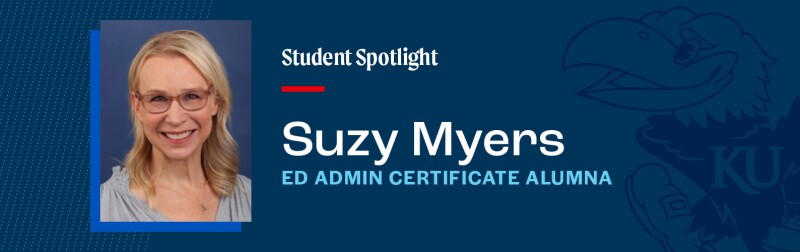
Suzy Myers describes herself as "just a learner"—someone who loves "doing new things, trying new things, jumping out into the unknown." It's a self-portrait that fits. Over the course of a career spanning the classroom, state government, and university research, Myers has continually sought out new challenges and wider horizons. And each move, it turns out, has built on the last.
Myers started as a high school English teacher, spending eight years across a couple of different school districts before a colleague recruited her to the Kansas State Department of Education, where she served as the English Language Arts Lead for Standards and Assessment. "I made a lot of really awesome connections, and got to know a lot of amazing educators here in Kansas," she told us—and throughout the country, too, as the role had her traveling nationally to collaborate on solutions to shared challenges in education.
Her primary charge at KSDE was statewide ELA standards implementation, and she was the only person in the state with that responsibility. "It was my boss and me trying to figure out how to get standards training and implementation support to every K-12 educator in the state of Kansas for English language arts." The scale of the problem pushed her toward creative thinking: virtual professional development, virtual communities of practice—which became the subject of her doctoral dissertation, earned while she was still at KSDE—and virtual coaching, which remains one of her active research lines today.
In 2018, Myers made the move to KU's Center for Research on Learning, where she now serves as co-director. The center, which was founded in 1978 out of KU's Department of Special Education, operates entirely on grants and external contracts. "It's a very sing-for-your-supper kind of thing," she said. "We have to write grants and make connections to get external contracts to fund ourselves and others within our center." The work is focused on translating research into practice: building tools and interventions that make educational experiences better for teachers and students.
Currently, Myers is helping scale a project in its fifth year to partner with state departments of education nationally; leading a curriculum development project funded by the Library of Congress; spearheading an effort to start a NE Kansas literacy center with partners at KU and another university; directing research and development work for the Kansas Board of Regents; and co-leading a project that has produced an AI-powered writing instructional tool for middle schoolers. "I was just up in Montana last week watching the middle school kids use this product that didn't exist two years ago," she said. "That's very exciting."
A Practical Decision—and a Personal One
With a bachelor's degree in journalism from KU, a master's in curriculum and instruction from K-State, and a doctorate from KU already behind her, Myers's decision to pursue the EdAdmin Certificate might seem surprising. She's candid about what drove it.
"In the field of education, it's challenging to move up if you don't have an administrative license," she noted. At the State Department, she had seen opportunities—even for roles squarely focused on professional learning and curriculum—close because she lacked licensure. "I always felt like, ‘What is it that those people know that I don't know?’ The credential gap was real, and Myers was pragmatic about it. "I felt like I had more options with a master's degree in administration than I did with a doctorate in curriculum and instruction, unfortunately."
Her position at the Center for Research on Learning added another layer of motivation. With no tenure track and no guaranteed funding, the role carries inherent uncertainty. "It was a thing to do to give myself a little bit of extra job security," she said. "It's a very practical reason."
Welcome to Jayhawkville
Ask Myers about her experience in the EdAdmin Certificate program, and she'll talk about Jayhawkville. The fictional community, complete with its own school district, staff dynamics, budget pressures, and all the messy human realities of a real Kansas town, runs as a throughline across the EdAdmin Certificate curriculum. Students are regularly asked to step inside it, apply what they're learning, and work through how they'd handle the situations they find there.
"I loved any assignment that we had to go into Jayhawkville," Myers said. "It made it so much more real for me." Having spent years in classrooms, at a state agency, and in a research center deeply connected to schools, she was well positioned to evaluate how realistic the scenarios felt, and she found them impressively so. "From my State Department role, from this role, from being in a couple of different school districts—and I also am the child of educators—I've been in a lot of different school districts and heard the intimate details about a lot of different dynamics that are happening, and it was so true to life."
She most appreciated the nuance baked into the scenarios. "There's no one absolutely 100% correct way to lead," she reflected. "There are a lot of different ways to do it right." The instructors, she added, were consistent in reinforcing that message: acknowledging that while there are definitely wrong approaches, good leadership is about finding what fits your style, your staff, and your resources. "I always appreciated that."
Beyond Jayhawkville, Myers noticed the same commitment to application running through the coursework more broadly. The prompts and instructors, she felt, kept returning students to the truths of what building leadership actually involves. "I think it would prepare anybody for the realities of what it's like to be a building administrator—all the challenges and the joys and the wonderful things about it, but also the hard, difficult things—and really give you a good background in how to navigate all kinds of issues."
An Unexpected Shift in Perspective
Myers came into the program with no intention of becoming a building principal. That wasn't her path, and she acknowledged it at the outset. "I went in knowing there's going to be some cognitive dissonance, to imagine that I could be in that role." She was transparent about that with the program from the start.
But something shifted over the course of her studies, and she credits both the coursework and her internship mentor, whom she described as "incredible." "By the end of it, I thought, you know, it wouldn't be so bad to be a building leader. I can see how that would be exciting. And I credit the program for that."
The program was also affirming in a deeper sense. It confirmed that the knowledge and expertise she had built over her career were real and substantive. And it gave her a new lens she hadn't expected: "It's not always just about knowing the thing; it's being able to look at a situation from the perspective of a curriculum leader versus a building administrator, and what are the areas of alignment, and what are the tension points between those two perspectives, and how to reconcile that."
The staff supervision coursework was a particular standout. "It's given me a greater understanding for human resources-related things, which I do have to deal with now: evaluations, processes, things you can say, things you can't say. That was really nice." She also valued the historical grounding the program provided: understanding why education law and policy look the way they do today, and tracing those threads back through civil rights legislation and beyond.
Why KU
Myers's relationship with KU runs deep. She earned her undergraduate degree here, her doctorate here, and now works here, and she's thought carefully about what makes the institution worth returning to.
"KU has nationally ranked programs, and they are that for a reason," she said. "They have excellent access to leaders in the field in a variety of disciplines within education: special education, curriculum and instruction, school psychology, measurement. All of those people in those programs are amazing, with bountiful knowledge and a lot of great connections that are really important if you're going to grow as a leader or as an educator beyond your time at KU."
She also addressed something she thinks Kansas, and Kansans, sometimes overlook. "We look outside of Kansas all the time to find solutions to what's happening in Kansas. And we in Kansas have internationally recognized experts in their field." KU, she said, has both a local commitment to doing good things for Kansas people and "powerful connections all over the country that can really help to take a seedling idea and grow it to a really exciting place."
For anyone weighing a graduate program in education, her advice is grounded in that same appreciation for application and real-world relevance that she found in the EdAdmin Certificate program. "KU has nationally ranked programs," she said. "And the connections you make—they matter."
Take the Next Steps Forward
Suzy Myers came to the KU online PK-12 Certificate in Educational Administration program with a doctorate already in hand, years of state-level policy experience behind her, and a clear-eyed, practical reason for enrolling. She wasn't chasing a principalship. She was investing in herself: building the credentials and the perspective to lead at the highest levels of her field, wherever that might take her.
Her story is a reminder that the EdAdmin Certificate isn't solely for teachers on the assistant principal track. It's for education professionals at every stage and in every corner of the field who want to deepen their leadership knowledge, expand their options, and bring a more complete toolkit to the work they're already doing.
This is the time for you to move ahead. KU's admissions outreach advisors are ready to help you explore the online PK-12 Certificate in Educational Administration and what it can mean for your career.