

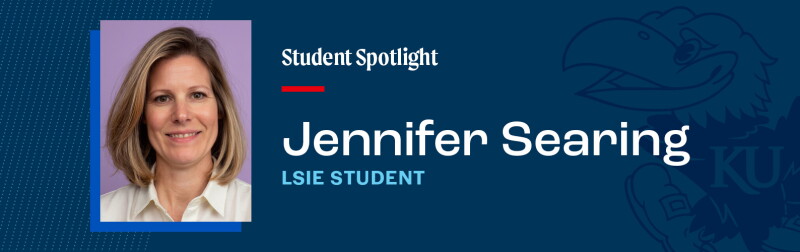
After more than two decades in education, Jennifer Searing knows that learning rarely looks the same for every student.
That belief shaped her years as an elementary and special education teacher in Maryland and Virginia, where she helped students with diverse learning needs build confidence and grow academically. It’s also what led her to the University of Kansas online Graduate Certificate in Leadership in Special and Inclusive Education (LSIE), a program that has allowed her to deepen her understanding of inclusive practices while reflecting on what comes next in her career.
Now living in Kansas after relocating with her family, Searing found herself in a season of transition. Rather than rushing into another classroom role, she decided to use the moment as an opportunity to grow professionally and explore new ways to contribute to the field of education.
“I think with the potential to transition out of the classroom, going back to being a student for a little bit helped me reconnect with the things I like to do,” she said.
Evolving education with research—online
Searing’s interests have long centered around research, instructional strategies, and finding better ways to support students. Early in her career, Searing taught kindergarten and first grade before realizing she was especially drawn to working with students who needed additional support. Over time, she pursued a master’s degree in learning disabilities and transitioned fully into special education.
While working in special education, Searing enjoyed the ability to continuously refine her teaching approach and see firsthand how small changes could make a major difference for students.
“I always felt like there was an opportunity to really look at what the research said is impactful for these students,” she said.
That curiosity about research and instructional improvement made KU’s online certificate program a natural fit. The program focuses on leadership and inclusive education practices while giving educators the flexibility to continue balancing work and life responsibilities.
At first, Searing wasn’t entirely sure what to expect from online learning. Although she had taught virtually during the pandemic, being an online student herself felt unfamiliar. She quickly found the program’s structure approachable and easy to navigate.
“Everything is very clearly laid out,” she said. “Getting access to Canvas was very easy and simple to navigate.”
More importantly, she found that the coursework reflected the same inclusive principles educators are encouraged to bring into their own classrooms.
One concept that particularly resonated with her was Universal Design for Learning (UDL), a framework that encourages educators to plan for learner variability from the start rather than retrofitting accommodations later.
Throughout the program, Searing experienced those principles in practice. Assignments often allowed students to choose how they demonstrated their learning, whether through written papers, audio recordings, or video submissions. That flexibility reflected one of UDL’s core principles: Multiple Means of Expression.
For Searing, the experience reinforced the idea that inclusive teaching begins with thoughtful design and a willingness to recognize that learners engage differently.
KU’s strength in legacy
The online LSIE program also connected Searing to a broader educational community. Although the coursework is online and asynchronous, she appreciated interacting with classmates and learning alongside educators from different backgrounds and parts of the country.
She was equally drawn to KU’s longstanding reputation in special education and educational research.
“When you look at KU and their program, they do have several programs that are ranked number one,” she said.1 “You’re getting to read things from folks in the field. A lot of times we were reading papers that were written by some of the past or present professors at KU. The institution has a storied history of making progress in this field.”
As Searing nears completion of the program, she is still exploring exactly what her next professional chapter will look like. What she does know is that she wants to continue helping bridge the gap between educational research and classroom practice potentially through nonprofit work, educator support, or other collaborative roles outside the traditional classroom.
“I think it’s so important to close that research-to-practice gap,” she said.
For an educator who has spent her career focused on helping students feel supported and included, the program has offered more than professional development. It has provided space to reflect, reconnect with her passions, and imagine new ways to make an impact.
To learn more about KU’s online education programs, visit our website or connect with an admissions outreach advisor to learn more.
- Retrieved on May 26, 2026, from usnews.com/education/online-education/university-of-kansas-155317