

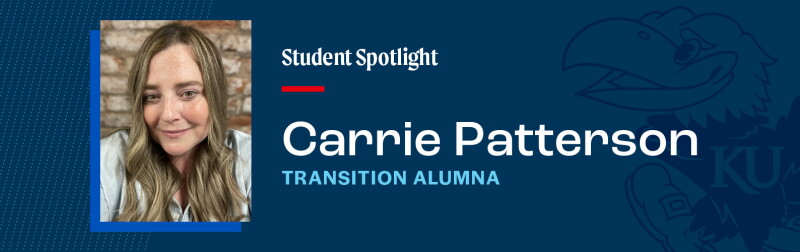
Some career paths are carefully planned. Others begin with a phone call from the right person at the right time.
For Carrie Patterson, a connection through her mother, a retired occupational therapist, led Patterson to a brand-new job coaching program being launched at a local community college. Patterson applied, not entirely sure what she was signing up for. What she found on the other side of that chance opportunity would shape the next several decades of her life.
Working side by side with students with disabilities in real workplace settings, Patterson quickly realized something that has stayed with her ever since. "Things that you and I take for granted," she reflects, "a lot of people don't know how to do." Skills like choosing the right shoes or the right coat for the weather, could be the difference between a student succeeding or struggling in a work environment .
That realization lit a spark. What started as an entry-level position evolved into a wide-ranging career in transition services. Seeking further career growth, Patterson returned to a place she'd always loved: the University of Kansas, this time as a graduate student in the online certificate and then master’s program in secondary special education and transition.*
Building a career one step at a time
Few professionals arrive at transition services with the depth of experience Patterson brings to the table. Her career didn't follow a straight line but each role added a new layer of understanding to what effective transition support really looks like.
After her first job coaching position, Patterson’s colleagues recognized what she was capable of. She was soon promoted into a newly created role, job developer, built around her strengths. Where job coaching meant working directly with students on the job site, job development meant going out into the community to build relationships and open doors with potential employers. "I would go to a grocery store and say, hey, this is our program," she recalls, "and then they would say, great, we need 10 of your kids to come work." It was advocacy in action, and she thrived in it.
Patterson went on to work at a therapeutic school serving students with behavioral and emotional disabilities, then took on a role as a vocational coordinator at a private therapeutic day school on the south side of Chicago working with students from under-resourced communities, many of whom faced significant barriers beyond the classroom including time spent in institutions and insecure housing.
When that school was acquired by another organization, Patterson moved to a therapeutic day school on the north side of Chicago, where she served as workforce development and transition specialist. There, her responsibilities expanded further: attending individualized education program (IEP) meetings, conducting student assessments, building work-based learning opportunities both inside and outside the school, and eventually writing transition plans. She came to understand, deeply, how the entire IEP process is built around transition. "If a student wants to be a carpenter," she explains, "how are we going to match those annual goals with that employment goal?"
Next came a role with a special education cooperative, where Patterson managed a grant as the Division of Rehabilitation Services Youth Coordinator. In this role Patterson ensured students could access pre-employment transition services and connected them with adult rehabilitation agencies that could help fund community college, four-year universities, and employment support after graduation.
Then, in January, an opportunity came along that she describes simply as a dream. A transition specialist position opened at a large, diverse high school in Oak Park, Illinois. What began as an interim role has since become a full-time position where she now mentors teachers in transition practices and serves as the primary link between students with higher needs and the outside agencies that can support them long after they leave school.
It's a career that took many roads. But as Patterson sees it, every single one of them was essential. "I may have taken the longer way to get here," she says, "but knowing that job coaching side, the job development side, the employment side—it helps in every situation."
Why KU: A Jayhawk returns
Patterson’s relationship with KU began long before graduate school. Growing up in the Chicagoland area, Patterson discovered that KU hit a particular sweet spot for an undergraduate student: far enough away to feel like a real college experience, close enough for an affordable flight home.
Fast forward to today: when Patterson's employer offered tuition reimbursement she began searching for a graduate program in transition services. It didn't take long for KU to come back into the picture. Word had reached her through colleagues that KU offered something rare: a master's program and a certificate specifically focused on secondary special education and transition, and one that didn't require applicants to be licensed teachers. For someone who had built an entire career in transition services outside of a traditional teaching role, that distinction mattered enormously.
"I was blown away," she says.
Taking a practical approach, Patterson decided to start with the graduate certificate to test the waters, assess the workload, and make sure the investment made sense. It didn't take long for her to have her answer. "I loved it," she says, "so I decided to apply for the master's."
For Patterson, the program's value comes down to a combination of factors that are hard to find in one place: its focus on transition, accessibility to non-licensed professionals, the credibility of the KU name, and especially, its affordable price point. "I would recommend it," she says. "I think it's an affordable program, and it can really help." She also points out that transition planning is one of the primary drivers of the IEP, putting certificate holders in an influential position.
Learning that works in real time
"I literally use [what I learn in class] in my day-to-day," she says. Concepts covered in class show up in her work almost immediately and she adapts topics from her coursework for the teachers she mentors. When studying transition plan writing, including making age-appropriate assessments, the difference between formal and informal assessment tools, and how to use that data effectively, Patterson noted that it was almost exactly what she was working on in her school at the same time.
That kind of real-time alignment isn't a coincidence so much as a reflection of how directly the program is built around the actual work of transition professionals. Patterson has years of experience writing transition plans, facilitating IEP meetings, and connecting students with pre-employment transition services. She says that the curriculum doesn't just confirm what she already knows, but builds on it. "This class literally aligns with everything that I've done, but just makes me more up-to-date and sharper," she says.
Perhaps most valuably, the program gives her something that can be surprisingly hard to find in a specialized field: outside validation. Transition services can be isolating work. Professionals in the field often operate as the lone expert in their building, hoping they're teaching the right things, using the right frameworks, pointing colleagues in the right direction. The program has become a touchstone for Patterson to check her knowledge against current research and best practices.
Online and in-sync
Patterson is also quick to praise the faculty. Instructor Stacie Dojonovic, Ph.D., co-coordinator of the transition program and Executive Director of the Council for Exceptional Children's Division on Career Development and Transition, stands out to Patterson for her responsiveness, encouragement, and the way she pairs video presentations with readings to make complex concepts more accessible. "Dr. D is awesome," she says.
Despite her concerns that online learning might feel isolating, Patterson has found genuine community among her classmates. Students in the program connect through group messaging to troubleshoot assignments, share experiences, and support one another—particularly those who don't work directly in a high school setting and may need to adapt coursework to their own context. "It feels different than an in-person class," she acknowledges, "but I like it because it is a lot of work, but it works with your own time."
The "why" behind the work
Ask Patterson why she has spent her entire career in transition services, and her answer is immediate.
"Helping students find a job is life-changing for kids in special education," she says. "It's independence, it's money, it's building social relationships. It is something that they will need for the rest of their life."
For Patterson, employment isn't just a nice idea for students with disabilities—it’s the key that unlocks everything else. She’s seen it enough times, across enough schools and communities, to know what's at stake without transition. "The world isn't kind for kids in special ed after they leave high school," she says. "So it's really important for them to be linked with agencies that can help them."
That sense of urgency is what has carried her through roles that were, by her own admission, hard at times. But she’s determined to not let students fall through the cracks when the structure of school is no longer there to catch them.
It's also why she takes her role as a resource for other educators so seriously. At her current school, Patterson works directly with teachers to strengthen their understanding of transition planning because she knows that the quality of a student's transition experience depends not just on the specialist in the building, but on the entire team around them. "Providing education and transition to parents, staff members, students, all the way around," she says, is part of what the work demands.
The KU program, she notes, has helped her do all of this better. It has pushed her to be more intentional about involving families, more rigorous in her use of assessments, and more confident in the guidance she passes on to colleagues.
Worth it: Patterson's case for the KU master's
Patterson didn't need the master's degree to get her current job. But she'll tell you that earning the degree is one of the best decisions she's made.
"I think it's a great degree to have that a lot of people don't," she says. And she's been putting that conviction into practice by actively encouraging colleagues in the transition field to look into the program. Her pitch is straightforward: the coursework is immediately applicable, the online format is flexible enough to work around a full-time job, the faculty are deeply knowledgeable and genuinely invested in their students, and the price point makes it a realistic option for working professionals. "I would tell anybody to take this program," she says. "For sure."
The small world of transition services has a way of confirming her enthusiasm. The professional who held Patterson's position before her completed the KU master's program, as did another teacher at the same school. In a field where expertise is rare and specialized knowledge can be hard to come by, the KU program has quietly become a credential that people in the know recognize and respect.
For Patterson, the journey from that first job coaching opportunity to her current role as a transition specialist at one of Illinois's largest high schools has been long, varied, and deeply rewarding. The master's program hasn't changed the direction of that journey, but it has sharpened the tools she brings to it every day.
"I've had the background," she says, "and this is just enhancing everything and making sure that I'm up to date." In a field where the stakes are as high as they are, that kind of commitment to growth isn't just admirable. It's exactly what students with disabilities and their families need from the professionals in their corner.
Deepen your expertise and advance your career
If you’re interested in building skills in evidence-based transition assessment and planning, interagency collaboration and creating a professional portfolio of research-based practices, consider the online special education transition programs from KU.
Neither the transition certificate nor the master’s program require a teaching license to apply, making admission an easier option for professionals working within, or tangentially to, education, who want to build skills and grow their careers without becoming a teacher. For more information contact an admissions outreach advisor.
*This master’s program is an online Master of Science in Education (M.S.E.) degree in special education with an emphasis in secondary special education and transition. It does not lead to initial nor advanced licensure in special education. In order to enroll in this program, a bachelor's degree is required.