

KU Online Education Graduate Programs Blog
Blog Posts

Who would have thought that memes—those images, videos, and pieces of text that are copied, often modified, and spread via internet—have roots in ancient Greek?

Explore educational transition specialization and several careers available within it. Apply to the online graduate education programs at KU.

Explore whether or not the concept of learning styles is a neuromyth and discover how evidence-based practices can provide better approaches to education.

In the last decade, HyperDocs have made a big splash in education. Explore some of the reasons why. Apply to the online graduate education programs at KU.

Explore six of our favorite Math About Me classroom activities. To infuse a sense of personal immediacy into your curriculum at any point in the year, Math About Me activities can be highly useful.

As schools nationwide continue to use online and hybrid learning models into 2021, we’re taking this opportunity to suggest several ways to use this popular, productive structure: Google Classroom scavenger hunt.
When it comes to educating students in classrooms, teachers can use all the helpful resources they can get their hands on, This is another installation in our Teacher Blogger feature: Free Tech 4 Teachers.

The story of the 20% Project goes back nearly a century.
In 1923, while at an auto body shop in St. Paul, Minnesota, 3M engineer Richard Drew noticed a car painter struggling with tape that ineffectively kept paint from bleeding into ar...

For teachers and students alike, online learning is a challenge, but one that is likely to stick around. Learn about the ten reasons teachers should be preparing for this new reality.

Explore evidence-based practices and how they can help you enhance the education of students with autism spectrum disorder.
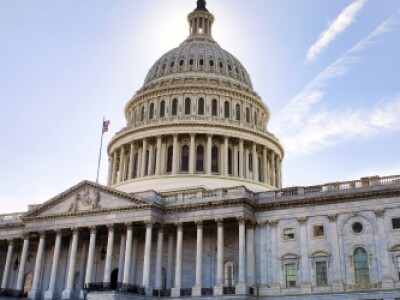
Explore the three most significant ones—Section 504 of the Rehabilitation Act, the ADA, and the Individuals with Disabilities Education Act.

Explore the changes in distance education due to COVID-19 and what they mean for the future. Apply to the KU School of Education and Human Sciences.

Explore 15 ways that you can advance social justice, individually and through alignment with like-minded people in your community and throughout the world.

There is no such thing as ‘one size fits all’ in special education. Develop your teaching skills further in the KU School of Education and Human Sciences.

Find support for special ed distance learning. Apply to KU’s online graduate programs in special education and enrich the lives of children.
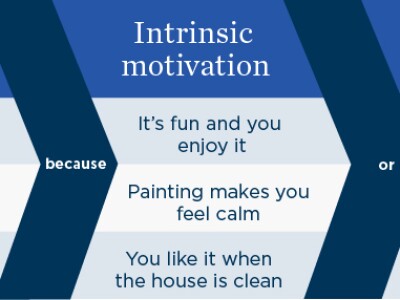
Teaching can be tough. To keep students engaged in class and online, build tools for teaching by intrinsic motivation. Apply to the online graduate education programs at KU to learn how.

Special education teachers follow many paths into teaching but they often share some personal characteristics, including creativity, enthusiasm and a passion for social justice.

Dive into the world of education and learn seven compelling reasons why the perks of being a teacher extend far beyond the classroom.

Effective instruction is a primary expectation of teachers across subjects and settings. Learn the definition of evidence-based practices and how to distinguish between scientific and pseudoscientific practices.

When the University of Kansas Department of Special Education decided to offer an online master's in high incidence disabilities,* we had to discover how to perform practicum supervision from a distance.

Learn about the challenges of supporting high school students with high-functioning autism in an inclusive classroom environment.
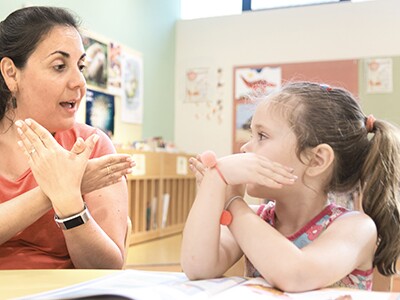
In jobs ranging from special education teacher to program director, those who work in the fulfilling field of special education transform the lives of children every single day.

Drs. Monica Simonsen and Cynthia Mruczek of the KU Department of Special Education discuss the ways words impact efforts toward inclusive education.
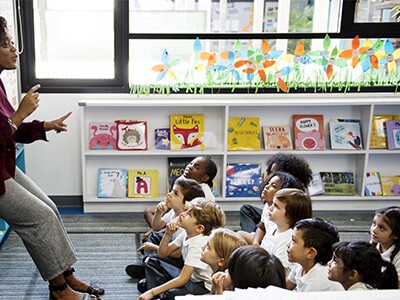
Before you pursue the education necessary to become a teacher, you should determine if teaching will make the best use of your strengths and fit your personality and life.
Parents and teachers of children with autism know that the keys to success in their education are patience, collaboration and mutual support between home and school. They also know that finding the time to review the latest research, as well as developing the skills to understand how to apply it, ca...
The U.S. Department of Labor reports that among individuals with disabilities between 20 and 24 years of age, the employment-population ratio was 36.9 percent in 2017. In contrast, the employment-population ratio for individuals without a disability in this age cohort was 67.3 percent
In order...
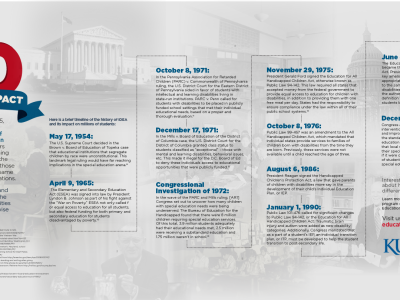
Uncover the fascinating history of the Individuals with Disabilities Education Act (IDEA) with our insightful infographic! From its inception to its evolution, learn about the milestones and impact of this landmark legislation.
In November of 2015, we celebrated the 40th anniversary of landmark legislation that removed barriers for children with learning disabilities to attend the same public schools as those who didn’t require unique educational accommodations.
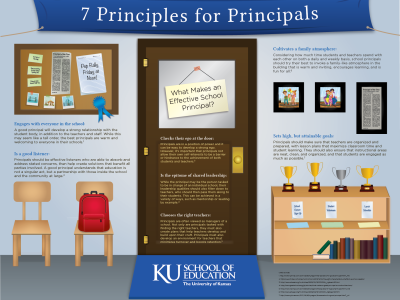
Explore practical ways to build a non-bully zone in your classroom. Learn effective strategies from KU experts to ensure that all students feel respected and valued.